Salesforce metadata
Objects, fields, Flows, Apex, validation rules, layouts and packages. Understand what has been built and how the configuration fits together.


COENNECT FOR SALESFORCE
Connect metadata, permissions, Setup Audit Trail, Event Monitoring, component usage and documentation across your orgs and sandboxes. Give your team the context to understand what is used, why it matters, who can reach it and what a change could affect.
Managed-package integration · Read-only by default · Production and sandboxes
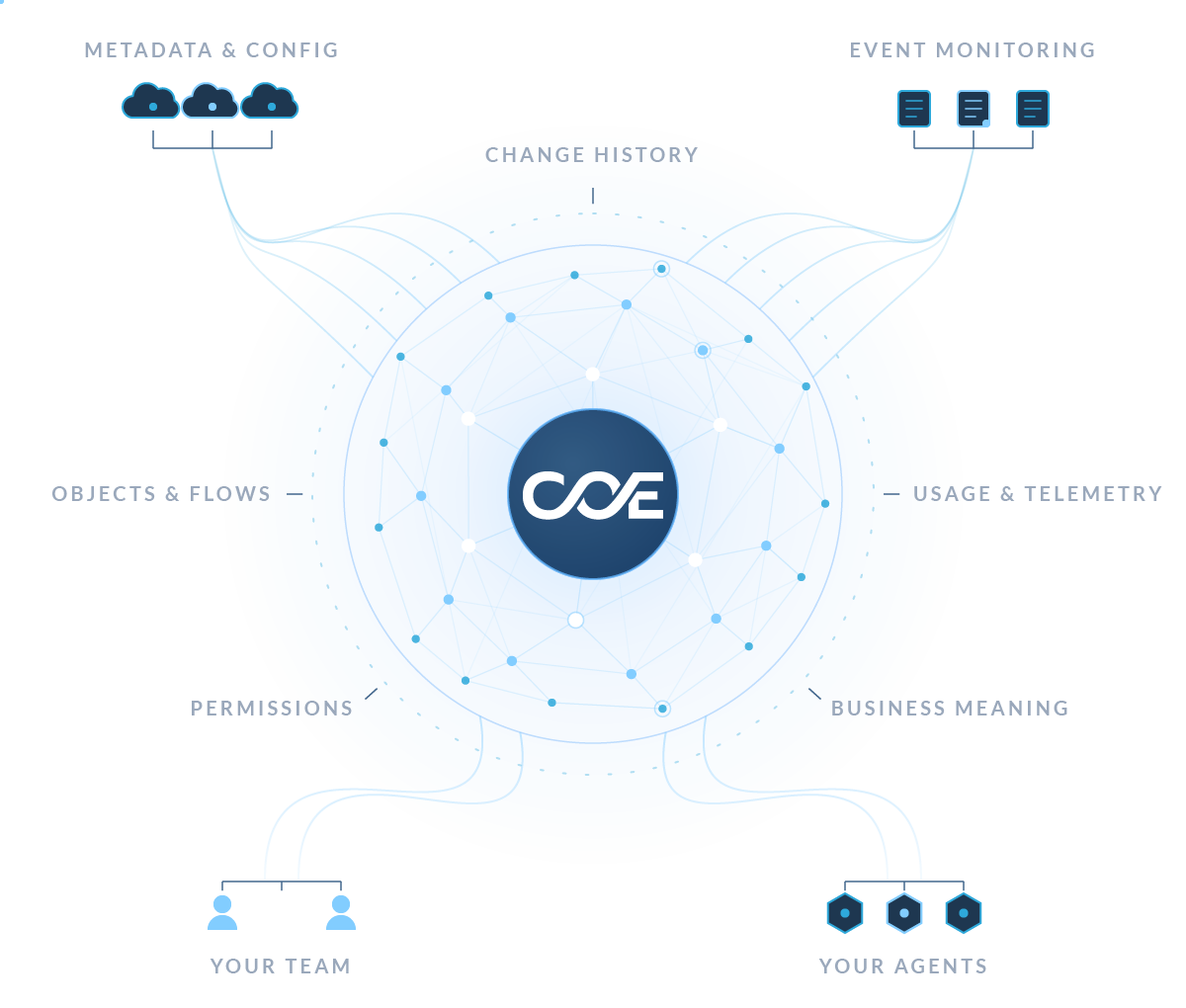
SIX SOURCES OF CONTEXT
An inventory is a starting point. Bring structure, access, change, behavior, utilization and knowledge together to understand your Salesforce environment.
Objects, fields, Flows, Apex, validation rules, layouts and packages. Understand what has been built and how the configuration fits together.
Profiles, permission sets, permission set groups, roles, sharing and licenses. Bring the evidence behind access into one review.
Configuration and administrative change history. Understand what changed, when it changed and what deserves a closer look.
Login, API, report, Apex and Lightning activity. Connect what is configured with the available evidence of what actually executed.
Understand which supported components are used, by whom and how often. Identify adoption gaps and candidates for further review.
Keep standards, runbooks, ownership and component explanations in the Docs Hub, alongside the environment they describe.
Coverage depends on the connected org, permissions, enabled features and available telemetry.
TEN CONNECTED CAPABILITIES
Each capability contributes a different kind of context, so your Center of Excellence can work from evidence rather than isolated reports.
FROM CONFIGURATION TO BUSINESS CONTEXT
A name like Region__c does not explain its importance. Usage, dependencies and documentation bring the business questions into view: Which process relies on it? Who uses it? What should be reviewed before it changes?
Business meaning brings observed behavior together with purpose, ownership and criticality, with human confirmation rather than assumed intent.
ILLUSTRATIVE EXAMPLE / NOT A CUSTOMER RESULT
Imagine this field drives territory assignment for 1,400 sellers, feeds three forecasting reports and is queried into a warehouse each night. Those relationships change the conversation from “Can we remove a field?” to “Which business process could we disrupt?”
Observe usage → review dependencies → confirm business purpose → preserve the explanation.
Draft review: automated owner, process and criticality inference, and the confirmation workflow, remain subject to product validation before publication.
MULTI-ORG GOVERNANCE
Bring connected production, sandbox, regional and acquired environments into one CoE operating view. Keep local context while building a consistent approach to enterprise oversight.
Move between a single org's detail and the connected portfolio's usage, license, API and sandbox picture.
Use comparisons and configured detections to surface differences from the standards your team expects.
Give admins, architects and CoE leaders a shared basis for deciding which orgs and findings need attention.
AGENTFORCE READINESS
Readiness starts with understanding the platform an agent will enter. Bring process usage, permissions, dependencies and documentation into the conversation before expanding agent access.
Coennect complements Agentforce. Your team retains responsibility for access decisions, approvals and changes.
Which objects and processes are actually used?
What access would the proposed agent receive?
What depends on the components it could touch?
Where does the business meaning still need confirmation?
BUILT FOR YOUR TEAM
A PRACTICAL STARTING POINT
Explore how event logs can support security, operational and adoption intelligence. Then see that evidence in the context of your own org.
SECURITY & CONTROL
The managed-package connection supports collection of defined metadata and activity signals from authorized orgs.
Coverage and history depend on access, available sources and ingestion. Missing telemetry is not proof that nothing happened.
Recommendations and AI explanations guide review. They do not replace your native controls or authorize production changes.
Discuss data handling, retention, hosting and assurance documentation with our team during your security review.
YOUR SALESFORCE CENTER OF EXCELLENCE
Start with the Salesforce challenges your team needs to solve.
Sold and deployed independently.


