Snowflake objects
Databases, schemas, tables, views, procedures, tasks, pipes and stages. Build a clearer picture of the supported objects in each connected account.


COENNECT FOR SNOWFLAKE
Connect Snowflake objects, roles and grants, access and query history, warehouse activity, consumption and documentation. Give your team the context to understand what is queried, who can reach it, what drives consumption and where to focus next.
Connected-account visibility · Metadata and usage context · Advisory guidance
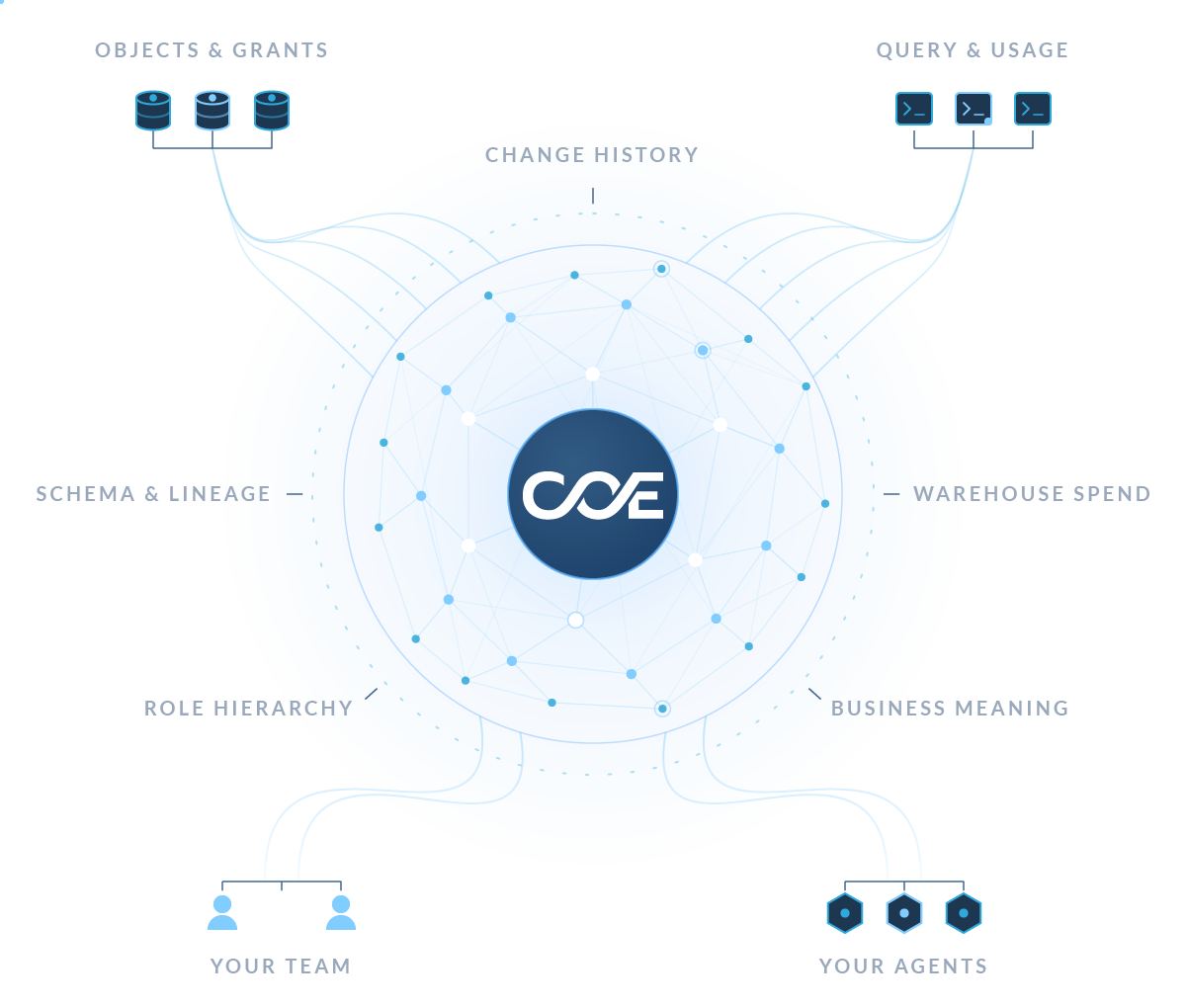
SIX SOURCES OF CONTEXT
Bring configuration, access, change, workloads, utilization and knowledge into the same conversation. Understand Snowflake as a platform your enterprise operates, not just a credit total.
Databases, schemas, tables, views, procedures, tasks, pipes and stages. Build a clearer picture of the supported objects in each connected account.
Users, roles, grants and available Access History. Review access configuration alongside evidence of how the account is used.
Account configuration and access changes. Understand the changes that may matter for standards, security and operations.
Query History, Sessions, Login History and warehouse activity. See workload behavior and recurring patterns in account context.
Supported object usage, warehouse activity, credit consumption and storage trends. Investigate staleness and inefficiency without assuming all growth is waste.
Keep data ownership, standards, runbooks and component explanations close to the account evidence they describe.
Sources, history and refresh timing depend on account access, configuration and supported collection.
TEN CONNECTED CAPABILITIES
Give platform, governance, security and cost owners a shared basis for understanding what deserves attention and why.
Draft review: dependency coverage, object-level utilization and other scope-sensitive claims require product validation before publication.
FROM OBJECTS TO BUSINESS CONTEXT
A table name does not tell you whether it supports the board's reporting, an abandoned experiment or a critical operational process. Usage, relationships and documented ownership change the quality of the decision.
The Business Meaning layer connects those questions to purpose, ownership, criticality and freshness, with the data team's confirmation rather than invented business intent.
ILLUSTRATIVE EXAMPLE / NOT A CUSTOMER RESULT
Imagine a table queried 3,000 times a day by a finance role that feeds a board dashboard. One pipe writes to it, while an older FACT_ORDERS table has not been read since March. The right review considers business purpose and dependencies, not just storage size.
Observe usage → review relationships → confirm ownership → preserve the explanation.
Draft review: automated business-meaning inference and the confirmation workflow remain subject to product validation before publication.
MULTI-ACCOUNT GOVERNANCE
Bring connected production, development, regional and acquired accounts into a common CoE operating environment. Keep account context while building a shared view of usage, consumption and governance.
Connect each relevant account with the access needed for supported metadata and usage collection.
Compare supported account records and use detections to focus attention on conditions that deserve review.
Give central and local teams a shared basis for reviewing consumption, storage, security and operational priorities.
Connecting one account does not automatically provide visibility into every account, region or cloud.
COST & SECURITY, WITH CONTEXT
Cost is one dimension of platform excellence. Review efficiency alongside access, reliability and the useful work Snowflake supports.
CORTEX & AGENT READINESS
Before expanding AI, understand which data assets are current, which access is appropriate and where ownership or business purpose still needs confirmation.
Bring readiness, adoption, security, governance, monitoring, consumption and optimization into a coordinated Cortex CoE conversation. Grow AI with oversight, not just another usage chart.
Which workloads are sensible starting points for Cortex?
Which models, interfaces and users appear in actual usage?
Are governance and access practices keeping pace?
What does AI consumption tell us about adoption and efficiency?
Readiness and recommendations are advisory. This page does not claim automatic agent access to the Context Graph, policy enforcement or autonomous production changes.
BUILT FOR YOUR TEAM
SECURITY & CONTROL
Collection operates within the supported metadata and usage access granted to each connected account.
Available sources, observation history and refresh timing affect what can be concluded. Missing data is not zero activity.
Your team evaluates recommendations through its own approval and change processes. Snowflake's native controls remain in Snowflake.
Discuss data handling, retention, hosting and assurance documentation with our team during your security review.
YOUR SNOWFLAKE CENTER OF EXCELLENCE
Start with the Snowflake questions your team needs to answer.
Sold and deployed independently.


